


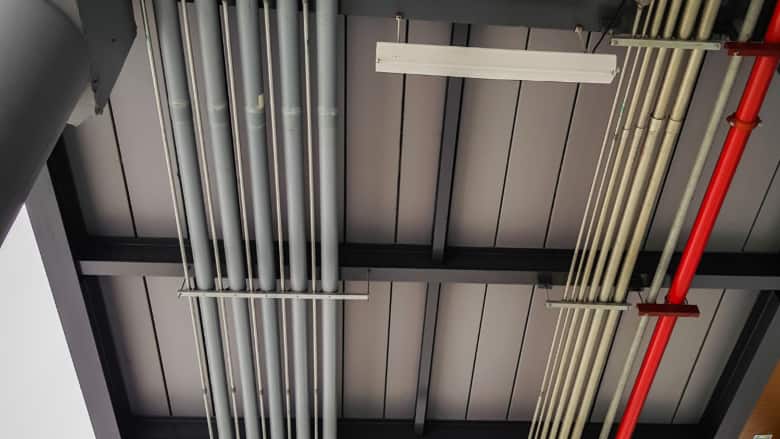
In many hyperscale and metropolitan data-center environments, existing microducts are already filled to filled to 90–95% capacity. Previous expansions placed up to 432 fibers per duct using conventional flat-ribbon or loose-tube architectures. Attempting to add another 2–4 PB of east– west capacity can require doubling fiber count per duct, a challenge in infrastructure originally designed for half that volume.
At this scale, conventional options are costly and disruptive. Installing new conduit in operational halls introduces six-to-nine-month construction cycles, seven-figure civil engineering costs, and operational risk due to downtime in live pods. Even in brownfield deployments, space constraints in underground pathways or shared ducts make new installations impractical.
This isn't an edge case anymore. It's becoming the default. Across North America, Europe, and mission speeds and network architecture, physical infrastructure, specifically, the limited space within existing cable ducts, has emerged as a strategic bottleneck.
The problem is particularly acute in mature markets. In Europe, FTTH/B coverage reached 74.6% of homes passed as of early 2025, with significant subscriber growth across the EU39 region. Global fixed broadband connections exceeded 1.53 billion in Q2 2025, with fiber-to-the home/building accounting for a dominant share of subscriptions. This rapid fiber proliferation has filled ducts originally designed for copper networks or early, lower-density fiber deployments
The challenge extends beyond residential markets. North American hyperscale operators face the same constraint as they build out AI training infrastructure and expand cloud capacity. One recent example: a major U.S. technology company undertaking a $65 billion data center and network expansion in 2025 encountered fully utilized 18/14 mm and 16/13 mm microducts across critical long-haul and metropolitan routes that needed to double in capacity to support planned deployments.
The Economics of Duct Exhaustion
Civil works represent the single largest cost component in fiber network deployment, typically accounting for 60-80% of total project expenses. Trenching, duct installation, and associated permitting processes can extend timelines by months while disrupting urban corridors and triggering community opposition.
In the UK, government pressure to limit telegraph pole installations has forced operators to maximize existing underground duct capacity. Similar dynamics are playing out across European markets, where regulatory frameworks increasingly favor shared infrastructure usage over new
construction. The result: duct space has become a strategic asset, with operators seeking technical solutions to multiply capacity within fixed physical constraints.
This shift has created market opportunities for cable manufacturers capable of engineering ultra compact designs that maintain or exceed performance specifications while dramatically reducing diameter. The innovation race centers on intermittently bonded ribbon (IBR) cable technology, where multiple vendors now compete to deliver the highest fiber density per square millimeter.
The Engineering Breakthrough: IBR Technology Reaches New Density Thresholds
The technical challenge of ultra-compact cable design centers on intermittently bonded ribbon (IBR) architecture, a structure that combines the mass-splicing efficiency of traditional flat ribbons with the flexibility and packing density of loose-tube designs. While the broader industry has explored various approaches to miniaturization, recent deployments demonstrate that specific engineering innovations are enabling unprecedented fiber densities.
HFCL's latest-generation IBR micro cables exemplify this evolution. The company's 864-fiber cable achieves 8.8 fibers per square millimeter in an 11.2 mm diameter, accommodating nearly double the capacity of earlier designs within the same physical envelope. For context, a 10.6 mm variant using ITU G.657.A1 fiber reaches 9.8 fibers per square millimeter, representing a high benchmark for cables using this backward-compatible fiber standard
The architectural innovations enabling these densities include:
200-Micron Fiber Transition: Moving from standard 250-micron to 200-micron fiber coating enables a 24% diameter reduction while maintaining optical performance parameters specified in ITU-T G.657 standards. This transition requires careful attention to mechanical protection, as thinner coatings reduce individual fiber robustness.
Tubeless Binder Yarn Construction: Eliminating buffer tubes and using binder yarns to organize ribbon stacks reduces cable weight compared to traditional loose-tube architectures. Lower mass directly improves air-blown installation performance, critical for achieving 1,000+ meter blowing distances at high duct fill ratios.
Composite Strength Member Engineering: Traditional FRP rods create rigidity that limits cable flexibility. HFCL's deployment of ARP (aramid-reinforced polymer) alternatives delivers structural integrity with lower bending stiffness, enabling tighter bend radii essential for navigating congested duct environments.
Luffa-Profile Sheath Optimization: A textured outer sheath reduces duct wall contact area while enhancing aerodynamic drag characteristics. Field testing shows that this innovation delivers 12.5% faster installation speeds compared to smooth-jacketed designs, a meaningful efficiency gain when deploying across multiple route segments.
Enhanced Compressive Strength: Early ultra-compact prototypes showed deformation under radial pressure during installation. Current designs achieve 1000N compressive strength without fiber attenuation degradation, meeting GR-20, IEC 60794-5-10, and ICEA S-122-744 specifications for outdoor deployment.
These technical advances converge to solve the fundamental constraint: fitting 800+ fibers in microducts originally designed for 288-432 fiber cables, enabling operators to double network capacity without civil works or duct augmentation.
Real-World Deployment Dynamics
Field performance separates theoretical specifications from practical deployability. Key success factors include:
Blowing Distance: Long-reach installation without intermediate access points reduces deployment costs. Achieving 1,000+ meter blowing distances at high duct fill ratios requires careful optimization of cable weight, flexibility, and sheath design. Innovations like Luffa-shaped sheaths, which minimize duct wall contact while enhancing air drag, have demonstrated 12.5% improvements in installation speed.
Bend Performance: High fiber counts traditionally correlate with increased cable stiffness. Operators deploying in congested environments require cables flexible enough to navigate tight bends without fiber stress. This has driven the adoption of alternative strength members beyond traditional FRP, including ARP, which provides structural integrity with lower rigidity.
Splicing Efficiency: Mass fusion splicing capability remains critical for operational economics. Bonded ribbon structures enable 12-fiber ribbon splicing in a single operation, reducing field labor by approximately 83% compared to individual fiber splicing. For networks with thousands of splice points, this translates to weeks of accelerated deployment.
Mechanical Durability: Early ultra-compact designs showed vulnerability to radial compression during installation. Current-generation products typically meet 1000N compressive strength specifications, ensuring fiber integrity under realistic handling conditions.
Market Adoption Barriers and Opportunities
Despite technical maturity, several factors influence adoption velocity:
Standards and Certification: Ultra-compact cables must comply with GR-20, IEC 60794-5-10, and ICEA S-122-744 standards. The relative novelty of 200-micron fiber designs means operators require extended field trial validation before large-scale deployment commitments.
Supply Chain Economics: Pricing dynamics favor established cable designs with mature supply chains. Ultra-compact alternatives command 15-25% premiums in current markets, though the cost differential narrows when factoring avoided civil works expenses
Installation Training: Air-blown installation of micro cables requires specialized equipment and technique. Operators must invest in workforce training and jetting equipment, creating switching costs that slow technology migration.
Vendor Lock-In Concerns: Some operators hesitate to standardize single-vendor solutions for strategic infrastructure. The proliferation of competing designs from multiple manufacturers addresses this concern, though it also creates standardization challenges.
Environmental and Regulatory Drivers
Sustainability considerations are reshaping procurement criteria. Ultra-compact designs deliver measurable environmental benefits:
• 47.5% reductions in HDPE usage per kilometer
• 46% lower carbon footprints across manufacturing and transportation • Elimination of civil works-associated emissions and disruption
• Reduced material waste throughout the product lifecycle
European operators facing increasingly stringent carbon reporting requirements view cable miniaturization as a lever for meeting decarbonization targets. The EU's connectivity goals, targeting universal gigabit access by 2030, must be achieved within environmental constraints that favor infrastructure reuse over new construction.
Industry Outlook: From Innovation to Standard Practice
The ultra-compact cable market is transitioning from early adoption to mainstream deployment. Key indicators suggest accelerating uptake:
Technology Maturity: Multiple vendors now offer comparable solutions, de-risking operator procurement decisions. Field deployments have validated performance across diverse environments, from hyperscale campus interconnects to metropolitan fiber rings.
Regulatory Alignment: Government pressure to limit new pole installations and maximize existing duct capacity creates policy tailwinds for miniaturization technologies. Open access mandates further incentivize efficient infrastructure utilization.
Economic Imperative: As fiber deployment shifts from greenfield to brownfield scenarios, avoiding civil works costs becomes paramount. The business case for ultra-compact solutions strengthens as operators exhaust low-hanging fruit deployment opportunities.
Capacity Pressures: AI workload growth, particularly training cluster interconnects and inference infrastructure, drives unprecedented bandwidth demands. Network operators must scale capacity rapidly, a requirement that favors duct reuse over years-long civil engineering timelines.
Strategic Implications for Network Operators
The evolution toward ultra-compact fiber cables represents more than incremental innovation. It signals a fundamental shift in network planning philosophy:
Asset Revaluation: Existing duct infrastructure becomes more valuable as a platform for capacity expansion. Operators with extensive duct networks gain strategic advantages over competitors dependent on new construction.
Deployment Acceleration: Long-reach blowing and microduct override techniques enable rapid capacity turn-ups. This agility matters increasingly in markets where competitive positioning depends on service availability velocity.
Future-Proofing: Dense, compact pathways ensure networks can scale ahead of demand. Installing 800+ fiber cables today creates headroom for decades of traffic growth, from emerging applications like spatial computing to unknown future services.
Environmental Performance: Compact cable adoption directly supports corporate sustainability commitments while potentially qualifying for green financing instruments and regulatory preferential treatment.
The Infrastructure Constraint Paradox
A striking irony defines the current moment: the same industry that has conquered challenges of 400G coherent transmission, real-time AI inference, and global-scale cloud orchestration finds itself constrained by 19th-century infrastructure decisions about where to bury conduits. The solution emerges not from revolutionary transmission technology but from incremental engineering refinements, smaller fibers, lighter cables, and smarter sheaths that enable dramatic capacity multiplication within fixed physical boundaries.
This pattern may prove instructive for other infrastructure bottlenecks. As digital networks continue expanding to support automation, electrification, and intelligence at network edges,
physical space constraints will recur. The cable industry's response, engineering density improvements that avoid disruptive reconstruction, offers a model for sustainable infrastructure evolution.
For operators navigating the transition from copper legacy to fiber future, and from fiber present to whatever follows, the lesson is clear, i.e., sometimes the most valuable innovation happens inside a 12-millimeter duct.
Disclaimer: This article contains sponsored content that may not reflect the independent opinion or views of FinancialExpress.com. Further, FinancialExpress.com cannot be held responsible for the accuracy of any information presented here.